
About the Project
CALL/RESPONSE
A Living Architectural Dossier
Call / Response proposes a speculative spatial practice rooted in orature – not as heritage to be preserved, but as a forward-projecting design method. Drawing from traditions of call and response, chant and collective storytelling, the project asks:
What forms of architecture emerge when space is imagined as an ongoing conversation rather than a fixed object?
It begins not with a building, masterplan or predetermined vision, but with a public call:
What does the future African city look like to you?
Write. Sketch. Speak. Record.
The responses – spoken, written, drawn and recorded – become the material of an evolving Living Architectural Dossier: a collective archive through which possible African spatial futures can be imagined, interpreted and projected.
WHY ORATURE?
Architecture is conventionally recorded through drawings, texts and authored objects. Yet much spatial knowledge on the African continent has historically also been transmitted through performance, narrative and lived practice.
Call / Response begins from the proposition that:
If architecture is spatialised thought, then orature represents a distributed, collective form of spatial thinking.
Through voice, story, chant and collective memory, knowledge of climate, ritual, governance and social life can be carried without necessarily taking the form of an architectural drawing.
The project asks what happens when these forms of knowledge are brought into architectural speculation. What happens when architecture begins by listening? And what might emerge when the spoken, remembered and imagined are allowed to become part of the material from which space is conceived?
Here, orature becomes a spatial technology – capable not only of carrying what has been, but of projecting what might yet be.
IMAGINATION AS METHOD
Call / Response is positioned within a condition of liminality: between inherited colonial spatial frameworks and emergent African self-authorship. Within this condition, imagination is not positioned as escape. It is method.
It allows futures to be articulated before they can be fully resolved — and opens architectural authorship beyond the singular designer towards a multiplicity of voices.
The project therefore does not ask participants to design a complete city.
A response may be:
- A building that does not yet exist.
- A reflection on a space of dignity.
- A redefinition of a familiar typology.
- A memory.
- A fragment.
- A contradiction.
- An impossible proposition.
Together, these contributions begin to organise a horizon: multiple, sometimes conflicting spatial imaginaries assembled into a shared field of possibility.
FROM CONTRIBUTION TO SPATIAL PROJECTION
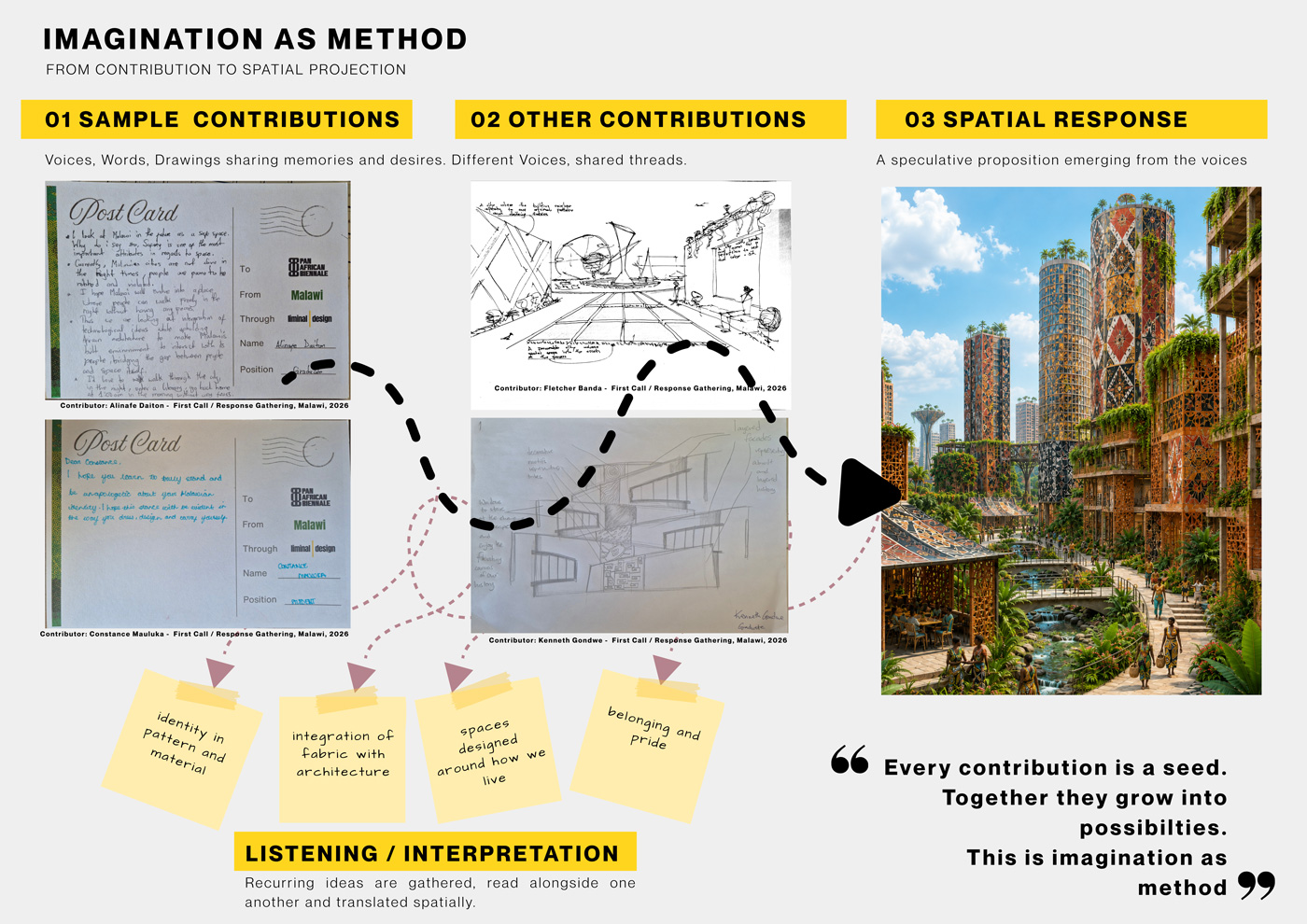
The contributions form the foundational material of the project. Some are allowed to remain exactly as they are: voices, postcards, drawings, photographs, texts and recordings. Others become prompts for further spatial exploration.
Recurring ideas, desires and spatial conditions within the contributions may be interpreted through drawings, moving image, architectural speculation and AI-assisted visualisation.
These generate evolving visual worlds – landscapes, architectures and spatial fragments that remain deliberately unresolved. The speculative images are therefore not proposed as definitive visions of an African future. They are responses. One possible spatial projection arising from something spoken, written, drawn or imagined.
A LIVING ARCHITECTURAL DOSSIER
The project does not seek to represent a singular future.
Instead, the Dossier accumulates.
- A voice joins a drawing.
- A drawing sits beside a proposition.
- One imagined world encounters another.
- Some contributions converge. Others conflict.
- New responses enter and alter what was there before.
The archive therefore remains deliberately incomplete — a system in formation rather than a finished artefact. Architectural authorship becomes collective, iterative and open-ended.
The Dossier is not intended to arrive at a final image of the African city.
It asks instead how architecture might listen, adapt and speak forward.
WHERE IT BEGAN
Call / Response began in Malawi in 2026.
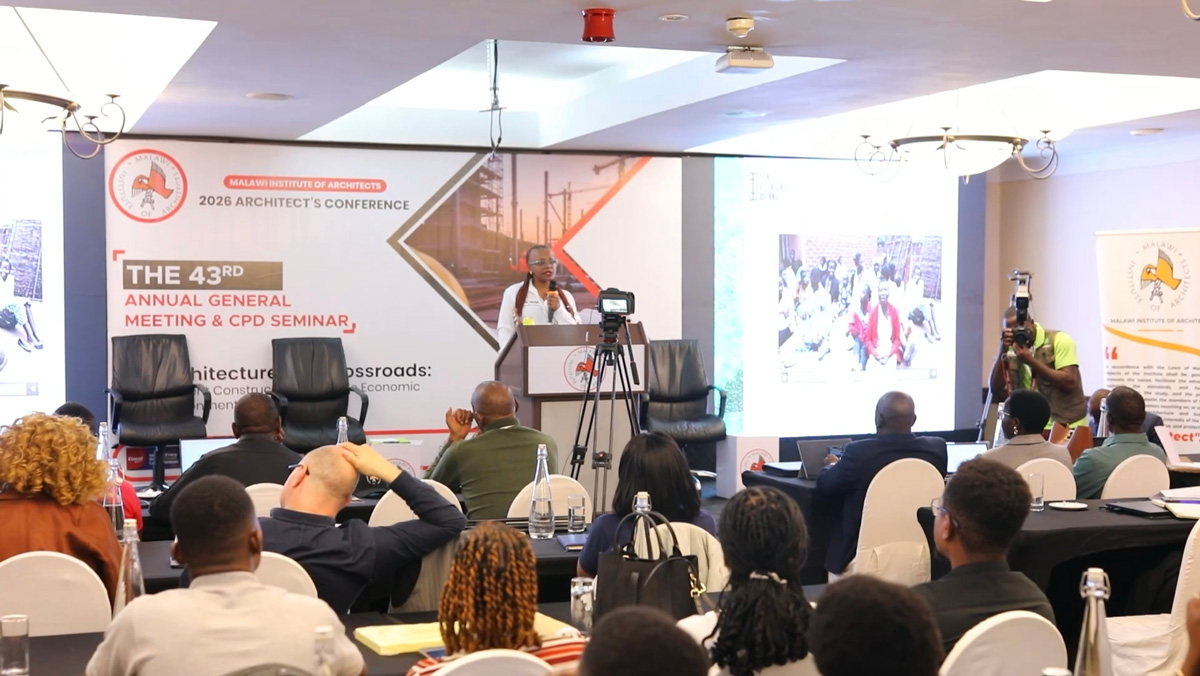
The first iteration took place within a professional gathering of architects, graduate architects and technicians, where participants were invited to contribute spatial propositions through speech, writing and drawing. These contributions formed the foundational archive of the project.
The gathering was made possible through the Malawi Institute of Architects, which provided the platform for the first Call / Response.
The project was subsequently developed by Liminal Design by Catherine Sani Ltd for the inaugural Pan-African Biennale 2026, a platform concerned with how African futures might be imagined and constructed from within.
At the Biennale, drawings, participant contributions, speculative spatial imagery and film extend that first gathering into a wider conversation.
The digital Dossier carries the conversation further still.
THE DOSSIER REMAINS OPEN
African futures are not approached here as distant constructs.
They are understood as active, collective processes already underway — emerging through everyday acts of storytelling, negotiation and imagination.
Call / Response does not seek to invent that future.
It amplifies one that is already being spoken.
What does the future African city look like to you?
Write. Sketch. Speak. Record.